Impact of Interest Rate Hikes on ASX Stocks in 2024: What Investors Need to Know
The impact of interest rate hikes on ASX stocks in 2024 was an important theme for Australian investors as the Reserve Bank of Australia (RBA) maintained a restrictive monetary-policy setting to bring inflation back towards its target.
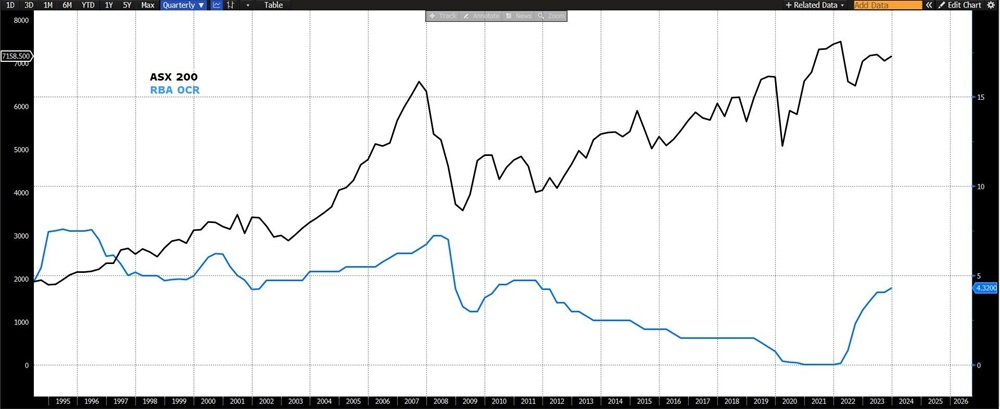
Although the RBA did not increase the cash rate during 2024, the year began with the cash rate at 4.35%, following the 25-basis-point increase delivered in November 2023. The rate remained at 4.35% throughout all eight RBA meetings held in 2024.
For investors, this meant that the effects of earlier rate increases continued to flow through household finances, corporate borrowing costs, property markets, consumer spending and company earnings.
The impact of interest rate hikes on ASX stocks in 2024 was therefore broader than the headline cash-rate decision. Different sectors responded differently depending on their debt levels, earnings sensitivity, valuation and exposure to the Australian economy.
What Happened to Australian Interest Rates in 2024?
The RBA entered 2024 with a cash rate of 4.35%.
The previous increase occurred on 7 November 2023, when the RBA lifted the cash rate by 25 basis points from 4.10% to 4.35%. The central bank said persistent inflation and strong services-price growth were key reasons for the decision.

During 2024, the RBA held the cash rate unchanged at:
- February
- March
- May
- June
- August
- September
- November
- December
At its December meeting, the RBA again left the cash rate at 4.35%, noting that underlying inflation remained around 3.5% and was still above the 2–3% target range.
This distinction is important when discussing the impact of interest rate hikes on ASX stocks in 2024.
The market was not reacting to a series of new hikes during 2024. Instead, investors were dealing with the cumulative effects of the aggressive tightening cycle that had occurred between 2022 and 2023.
Why Do Interest Rates Affect ASX Stocks?
Interest rates can affect listed companies through several channels.
Borrowing Costs
Higher interest rates generally increase the cost of borrowing.
Companies with substantial debt may therefore face higher interest expenses, particularly when loans are refinanced or variable-rate debt reprices.
Consumer Spending
Higher mortgage repayments and borrowing costs can reduce disposable income for households.
This can affect businesses that depend heavily on discretionary consumer spending.
Company Valuations
Interest rates also influence how investors value future corporate earnings.
When bond yields rise, the discount rate used to value future cash flows can increase, potentially placing pressure on some growth-stock valuations.
Economic Growth
Higher rates are intended to moderate aggregate demand.
That can eventually affect business investment, employment, consumer spending and corporate earnings.
The RBA noted in 2024 that higher interest rates were working to bring aggregate demand and supply closer towards balance.
Impact of Interest Rate Hikes on ASX Banks
Australian banks are particularly sensitive to interest-rate conditions.
Major banks generate revenue from lending, while also paying interest on deposits and other sources of funding.
The relationship between higher interest rates and bank earnings is therefore not straightforward.
Net Interest Margins
Higher lending rates can increase interest income.
However, banks also face higher funding costs and stronger competition for deposits.
This means investors need to look at net interest margins rather than simply assuming that higher rates automatically translate into higher bank profits.
Credit Growth
Higher borrowing costs can reduce demand for new mortgages and business loans.
Slower credit growth can eventually affect bank revenue growth.
Bad Debts
Higher interest rates can place pressure on highly indebted households and businesses.
If economic conditions weaken significantly, banks could experience higher loan impairments.
Bank Stocks in 2024
Despite the restrictive interest-rate environment, Australian bank stocks performed strongly during the period covered by the 2024 financial-year market data.
An ASX filing citing FactSet data showed that banks rose 34.9% during the 12 months to 30 June 2024, while the broader ASX 200 Accumulation Index rose 12.1%.
This illustrates why investors should not assume that rising or elevated interest rates automatically result in falling bank share prices.
For further sector analysis, see StockBinge's ASX Banking Stocks in 2026 – Opportunities, Risks and What Investors Should Watch.
Impact on ASX Consumer Stocks
Consumer-facing companies were another important area of the market.
Higher interest rates can affect consumer businesses in two ways.
First, households may have less disposable income because mortgage and other borrowing costs are higher.
Second, consumers may become more cautious about discretionary purchases.
Consumer Discretionary Businesses
Retailers, restaurants, travel companies and other discretionary businesses can be particularly exposed to changes in household spending.
When consumers prioritise mortgages, utilities and essential goods, discretionary spending can come under pressure.
Consumer Staples
Companies selling essential products can have somewhat different demand characteristics.
Food, household goods and other everyday products may remain relatively resilient, although businesses can still face pressure from higher wages, logistics costs and input prices.
Impact on ASX Property and REIT Stocks
The impact of interest rate hikes on ASX stocks in 2024 was particularly relevant to property companies and Australian Real Estate Investment Trusts (A-REITs).
Property businesses are often sensitive to interest rates because they use debt to finance assets.
Higher financing costs can affect:
- Property valuations
- Interest expenses
- Development activity
- Refinancing costs
- Distribution capacity
- Investor demand
However, property stocks can also respond to expectations about future interest-rate cuts.
An ASX filing covering the 12 months to 30 June 2024 reported that A-REITs rose 24.7% over that period, despite the higher-rate environment.
This demonstrates the importance of market expectations.
Share prices often reflect what investors expect to happen next rather than simply the current level of interest rates.
Impact on ASX Technology Stocks
Technology companies can also be sensitive to interest rates.
Many growth-oriented companies are valued partly on earnings expected several years into the future.
When interest rates and bond yields increase, future earnings can be discounted at a higher rate.
However, the Australian technology sector performed strongly during the 12 months to June 2024.
The same ASX filing reported that information technology stocks gained 28.4%, supported in part by growing interest in artificial intelligence and technology applications.
This shows that company growth expectations, industry trends and investor sentiment can sometimes outweigh the negative valuation effect associated with higher rates.
Impact on ASX Mining and Resource Stocks
The resources sector is influenced by a different set of factors.
Mining companies are particularly sensitive to commodity prices, Chinese economic activity, global industrial demand and exchange rates.
Interest rates can still matter because they affect global economic growth and the cost of capital.
However, commodity prices can be a more immediate driver for many resource companies.
The ASX filing covering the year to June 2024 reported that the resources sector declined 3.2%, with subdued Chinese demand for commodities cited as one factor.
This highlights an important point: interest rates are only one part of the equation for ASX mining stocks.
StockBinge's Fortescue and Other Mining Giants Reshaping the ASX in 2025 provides additional context on Australia's major mining companies.
How Interest Rates Affect Company Valuations
One of the less visible effects of interest rates is their influence on equity valuations.
Suppose two companies generate similar levels of earnings, but one has most of its expected cash flow many years into the future.
Higher discount rates can have a greater mathematical effect on the present value of those future cash flows.
This can make growth companies particularly sensitive to changes in bond yields and monetary-policy expectations.
However, valuation movements depend on many variables, including:
- Expected earnings growth
- Profit margins
- Debt levels
- Cash flow
- Competitive advantages
- Industry conditions
- Investor expectations
Therefore, interest rates should not be viewed in isolation.
Inflation Was Central to the RBA's Decisions
Inflation was the main reason monetary policy remained restrictive during 2024.
At the February 2024 meeting, the RBA reported that inflation had fallen but remained elevated at 4.1% over the year to the December quarter.
By May, headline CPI had moderated further, but services inflation remained persistent.
The RBA said inflation was declining more slowly than expected and noted continuing excess demand and strong domestic cost pressures.
By August, underlying inflation remained at 3.9% over the year to the June quarter.
The RBA noted that inflation remained above the midpoint of its 2–3% target range.
These conditions helped keep monetary policy restrictive throughout the year.
Interest Rate Expectations and the ASX
Investors do not wait for the RBA's official decision before adjusting share prices.
Markets continuously price expectations for future interest rates.
For example, if investors expect rates to remain higher for longer, they may adjust valuations before the RBA makes a formal announcement.
The RBA noted in May 2024 that market expectations for the Australian cash rate had shifted higher following stronger-than-expected inflation and labour-market data. Government and corporate bond yields also increased alongside changes in policy-rate expectations.
This means the impact of interest rate hikes on ASX stocks in 2024 included not only actual monetary-policy decisions but also changing expectations about the future path of rates.
Which ASX Stocks Are Most Sensitive to Interest Rates?
Sensitivity varies considerably between companies.
Banks
Banks can benefit from higher lending rates but may also face higher funding costs, slower credit growth and greater credit risk.
A-REITs
Higher financing costs and valuation changes can affect property trusts.
Consumer Discretionary
Household spending can weaken when borrowing costs rise.
Technology
Higher discount rates can affect valuations, particularly for companies valued on long-term growth expectations.
Infrastructure
Infrastructure businesses can have significant debt exposure, making financing costs relevant to earnings and distributions.
Mining
Commodity prices and global demand often have a greater direct influence, although interest rates can affect financing and broader economic conditions.
What Happened to the ASX 200 in 2024?
The market's performance during 2024 demonstrated that elevated interest rates did not prevent the ASX from generating gains.
The ASX 200 Accumulation Index rose 12.1% in the financial year to 30 June 2024, according to FactSet data cited in an ASX filing.
At the same time, sector performance was widely dispersed.
Banks and information technology stocks recorded strong gains, while resources underperformed during that period.

This divergence reinforces the importance of analysing individual sectors rather than assuming that interest-rate changes affect every ASX stock in the same way.
What Investors Should Watch When Rates Are High
1. RBA Monetary Policy
RBA decisions provide an important signal about Australia's monetary-policy direction.
2. Inflation
CPI and underlying inflation can influence expectations for future interest rates.
3. Bond Yields
Government bond yields can affect equity valuations and borrowing costs.
4. Corporate Debt
Companies with significant debt may be more exposed to refinancing costs.
5. Consumer Spending
Retail sales and household consumption can provide clues about economic resilience.
6. Bank Margins
Investors can monitor net interest margins, funding costs, credit growth and bad debts.
7. Earnings Growth
Ultimately, company earnings and cash flow remain central to equity valuations.
Interest Rate Impact Across ASX Sectors
| ASX Sector | Key Interest-Rate Sensitivity |
|---|---|
| Banks | Funding costs, lending rates, credit growth |
| A-REITs | Debt costs, property valuations, distributions |
| Technology | Discount rates and growth valuations |
| Consumer discretionary | Household borrowing and spending |
| Consumer staples | Household demand and input costs |
| Infrastructure | Debt costs and long-term cash flows |
| Mining | Global growth, financing and commodity demand |
| Utilities | Debt costs and defensive demand |
The table highlights why there is no single market response to higher interest rates.
Company balance sheets, earnings quality, industry conditions and investor expectations can all influence how individual stocks perform.
Frequently Asked Questions
What was the RBA cash rate in 2024?
The RBA cash rate remained at 4.35% throughout 2024. The rate had been increased to 4.35% in November 2023.
Did the RBA raise interest rates during 2024?
No. The RBA kept the cash rate at 4.35% at every scheduled monetary-policy meeting during 2024.
How did high interest rates affect ASX banks?
Higher rates affected both bank lending income and funding costs. Banks also faced potential changes in credit growth and loan quality as borrowing costs increased.
How did interest rates affect ASX technology stocks?
Higher rates can increase discount rates applied to future earnings, potentially affecting growth-stock valuations. However, technology companies can also be driven by earnings growth and industry trends such as artificial intelligence.
Why are REITs sensitive to interest rates?
REITs often use debt to finance property assets. Higher borrowing costs can affect interest expenses, valuations and distributions.
Do higher interest rates always cause ASX stocks to fall?
No. The market response varies by sector and company. An ASX filing showed that banks, information technology and A-REITs all recorded gains during the 12 months to 30 June 2024 despite the higher-rate environment.
Why did the RBA keep rates high during 2024?
The RBA maintained a restrictive policy setting because inflation, particularly underlying and services inflation, remained above the target midpoint.
Conclusion
The impact of interest rate hikes on ASX stocks in 2024 was shaped by the cumulative effects of the previous monetary-policy tightening cycle rather than by new RBA rate increases during the year.
The cash rate remained at 4.35% throughout 2024 after the November 2023 increase. The RBA maintained this restrictive setting while monitoring persistent inflation and economic conditions.
Yet the ASX demonstrated that elevated interest rates do not affect every sector in the same way.
Banks, technology companies and A-REITs recorded substantial gains during the 12 months to June 2024, while the resources sector faced a more difficult period.
For investors, the key issue is therefore not simply whether interest rates are high or low. The more relevant questions include how rates affect a company's debt, earnings, valuation, customers and future growth expectations.
Monitoring RBA policy, inflation, bond yields, corporate earnings, consumer spending and company balance sheets can provide useful context when analysing ASX stocks in changing interest-rate environments.
At StockBinge, we believe investors should conduct their own research and consider their investment objectives, financial circumstances and risk tolerance before making investment decisions.
Disclaimer
This article is provided for general information only and does not constitute personal financial advice. Investing in shares involves risk, including the potential loss of capital. Past performance does not guarantee future results. Investors should conduct their own research and consider seeking professional financial advice before making investment decisions.